Walking the Path
How I think about activism, leadership, management, and city government

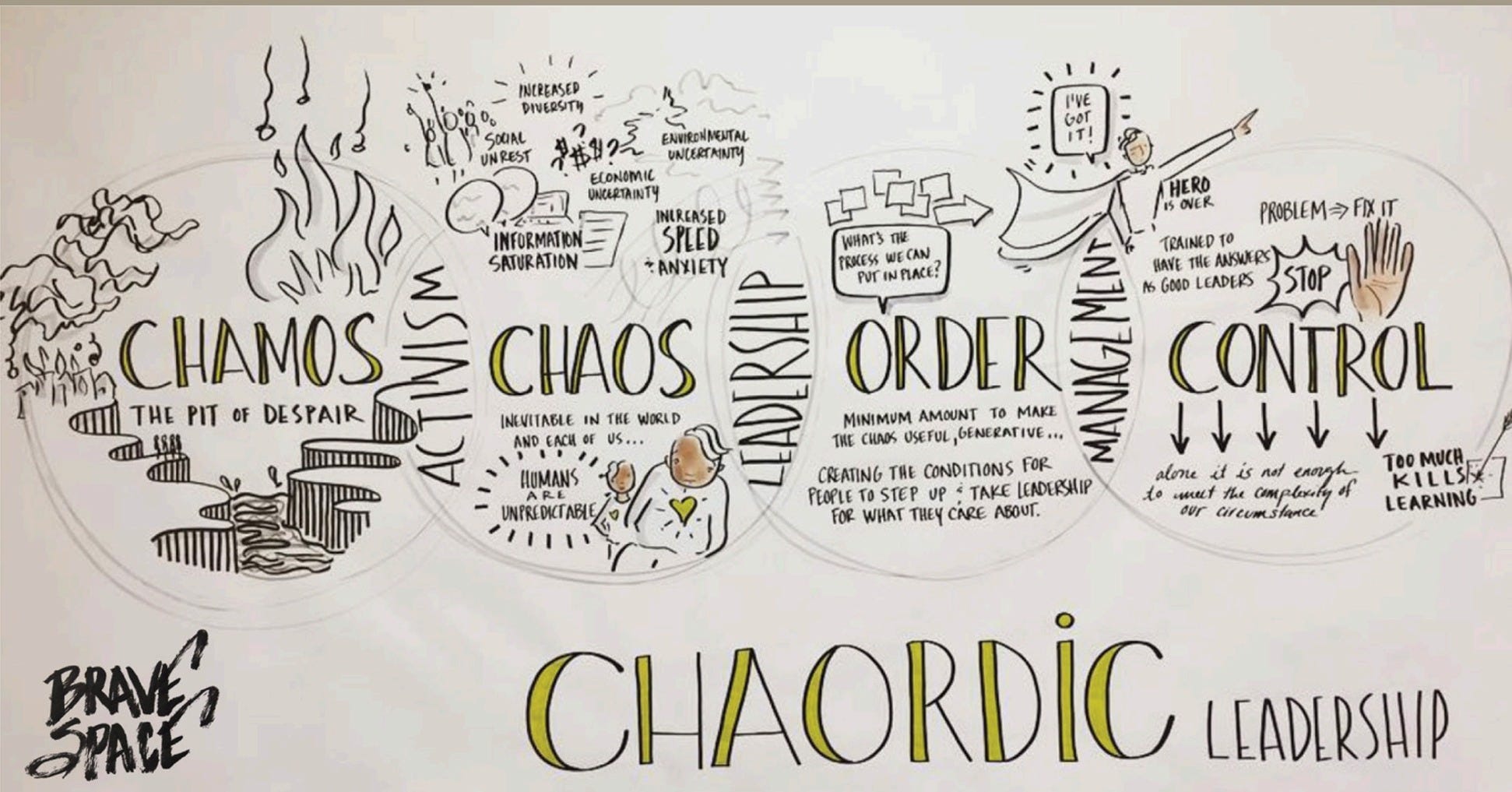
This post is going to be a bit more theory and framework heavy than most. That’s intentional.
I’ve found that a lot of frustration with city government comes from people looking at the same system through completely different lenses. So instead of starting with a specific issue, I want to lay out the framework I use when I think about governance.
This isn’t the only way to see it, but it’s the one I frequently use.
Real change doesn’t happen in stability. It also doesn’t happen in disorder. It happens in the space between them. That space can be described as part of the chaordic path. It’s where systems aren’t fully settled, but aren’t breaking apart either. It’s where new patterns can actually emerge. One of the core frameworks I use to think about activism, leadership, management, and city government starts there.
When I use the word activism, I’m not using it in a partisan sense. I mean people or groups advocating for change in response to perceived issues, gaps, or needs in the community. This shows up as residents responding to lived experience, organizations pushing for policy changes, or stakeholders raising concerns about how City systems are working in practice. It shows up as the friendly chat at the grocery store, the email sent to me, or the protest at the courthouse.
Activism, in this sense, is not external to government. It’s part of how feedback enters the City system. It’s directional pressure. It reflects where people believe something isn’t working or could be improved. The question isn’t whether activism is right or wrong (although the methods of expressing activism can certainly be right or wrong). It’s how that input gets received, filtered, and acted on within a government that also has legal, financial, and operational limitations.
In a government context, activism functions as a pressure and signal layer and usually shows up in three ways.
First, it highlights gaps between policy intent and lived experience.
Second, it brings forward priorities that may not surface through formal planning processes alone.
Third, it increases visibility around issues that might otherwise stay fragmented or not discussed.
Importantly, activism doesn’t map directly to decisions. It doesn’t determine outcomes on its own. It enters a broader City system that includes public process, Council deliberation, and administrative execution. That distinction matters, because a lot of frustration with city government comes from breakdowns in how these layers are understood or connected.
Leadership sits in the tension between chaos and order. The job of leadership isn’t to immediately resolve conflict. It’s to hold it long enough for something better than the initial positions to emerge. That requires comfort with uncertainty. It requires resisting the urge to force clarity too early. Many struggle here. They either make a decision too quickly or wait too long.
Leadership is the discipline of staying in that middle space until direction is actually ready to be set. Not before.
In my view, City Council’s role is to operate in the leadership space. It sets direction through public process. It weighs tradeoffs. It makes decisions in situations where there usually isn’t a clean answer. However, there’s another part of that role that’s often less explicitly named.
Council also acts as a kind of standard bearer for adopted direction. Council represents adopted priorities, shared goals, and long-term vision and advocates for them.
That doesn’t mean avoiding disagreement. It doesn’t mean pretending conflict doesn’t exist. It means that once a direction is set through public process, Council helps stabilize that direction so the City system isn’t constantly re-litigating what’s already been decided. Without that function, implementation and public understanding tend to fragment.
Management isn’t leadership. It’s something different, and just as necessary. Management lives on the order side of the City system. Its job is execution. Its job is consistency. Its job is making sure decisions actually become real-world outcomes. Management turns direction into implementation. It turns intent into City systems that people can rely on.
Without management, leadership stays abstract. Without leadership, management becomes maintenance of whatever already exists. Both are required, but they’re not interchangeable.
In practice, these distinctions matter a lot. City Council primarily operates in the leadership space. It’s responsible for setting direction through public process. It also serves as a public-facing body that helps stabilize and reinforce that direction once it’s established.
The City Manager operates in the management space. Once direction is set, the role is to implement it. That includes organizing staff work, delivering services, and translating policy into operational reality.
Activism operates as an input layer into the City system. It’s part of how issues are surfaced and how pressure enters decision-making over time. It doesn’t directly determine outcomes. It influences what enters the City system and how strongly it is felt.
When these roles stay distinct but connected, the City system is more coherent and easier to navigate. When they blur, confusion shows up both inside government and outside it.
A lot of frustration with city government comes from breakdowns in these distinctions. Sometimes City systems become too rigid, and change becomes difficult to process. Sometimes City systems become too reactive, and decisions never fully stabilize. The challenge isn’t choosing between those states. It’s learning how to move between them without losing clarity about roles.
The chaordic path isn’t comfortable. It isn’t clean, and it doesn’t produce immediate resolution. It’s where new solutions actually emerge. If leadership avoids it, City systems tend to stagnate or decline. If activism never connects to it, feedback loses its ability to shape outcomes. If management is asked to operate without it, execution loses direction. The work, at every level, is learning how to stay in that space long enough for something real to take shape.
This is a personal reflection and framework for understanding municipal governance. It is not an official statement of the City Council or the City.
I think this is a thoughtful framework, and I agree that activism, leadership, and management all play different roles in a functioning city system. But ultimately, residents judge government less by theory and more by outcomes, lived experience, and what they see every day on the ground.
People are seeing rising blight, open drug activity, vandalism, illegal camping impacts, struggling businesses, vacant storefronts, lower housing production, and growing concerns about public safety and economic stagnation. Those aren’t abstract concepts — they are lived experiences and observable realities throughout the community.
City Council absolutely sets priorities through Comprehensive Plans, Municipal Codes, budgets, and policy direction. But City Staff and Executive Leadership are responsible for executing those priorities and enforcing the codes already on the books. Citizens should be able to challenge BOTH policy decisions and operational execution. Both matter. Both are leadership roles with different responsibilities and different KPIs. Both policymakers and executive leadership have a responsibility to be rigorous in their analysis, transparent and intellectually honest with the public, demonstrate measurable outcomes, and inspire confidence that Port Angeles still has a vibrant future worth investing in.
Right now, too many residents feel like they are being asked to pay more, volunteer more, tolerate more, and receive less in return. Many feel local government is suggesting our best path forward is to just accept the current state of affairs as the "new normal". We blame DC. We blame Olympia. Maybe the finger pointing needs to be more directed at ourselves? This growing frustration is becoming impossible to ignore. Just this week alone, I heard people say things like: “I feel defeated,” “I’m halfway out the door and down the road,” and “A decade of fighting without concentrated support has left me numb to this area.”
That should concern all of us. Leadership is not only about managing systems and process. It is also about restoring trust, momentum, and belief in the future of the community. Good leadership also means having the humility to acknowledge when outcomes are falling short and the urgency to adjust course. The public is not frustrated because they misunderstand governance theory. They are frustrated because they want to see measurable real-world progress.
Thank you for this post; I recognize that being in leadership or management within bureaucracies is not an easy thing to do.
Whether it’s leadership or management roles, one thing connects them all — they are funded by tax dollars taken by people without choice.
You want to live here? There’s a tax for that. You want to shop here? There’s a tax for that. You want a business here? There’s a tax for that. You want to build here? There’s a tax for that. And it’s not just ‘a’ tax, it is multiple taxes and fees.
Leadership and management wouldn’t exist without tax dollars. And that’s what I see going unnoticed — there seems to be no recognition that it is the people paying the taxes that make everything happen, because government couldn’t exist without money they take.
Since the funding comes from taxes, it would be nice if leadership and management recognized who pays their salaries and overhead; and that being paid by tax dollars makes them public servants — servants to the taxed public — no matter what role they are in.